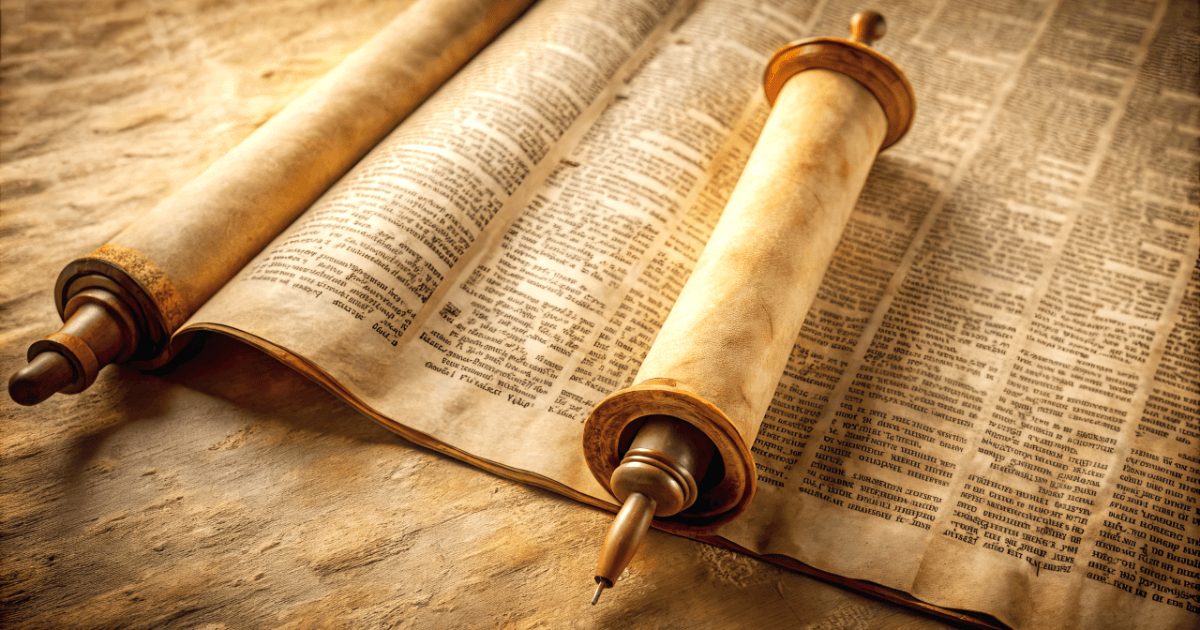
The belief that the Bible we hold today is the same Word that God inspired thousands of years ago is not a blind leap. It is a confidence supported by an incredible chain of evidence—from the sacred duties of ancient scribes to the stunning discoveries of modern archaeology. This study explores that evidence, revealing how God has faithfully preserved His Word.
📜Part 1: The World of the Scribe (Scroll to Scroll)
Before the printing press, every single copy of a document had to be made by hand. For sacred texts like the Hebrew Scriptures (the Old Testament), this was a meticulous and deeply revered process, carried out by highly trained scribes who believed they were handling the very breath of God. The prophet Jeremiah’s use of a scribe, Baruch, gives us a biblical glimpse into this ancient practice, where the words of God were dictated and painstakingly recorded:
"Then Jeremiah called Baruch the son of Neriah and Baruch wrote on a scroll at the dictation of Jeremiah all the words of the LORD that He had spoken to him. And they asked Baruch, “Tell us, how did you write all these words? Was it at his dictation?” Baruch answered them, “He dictated all these words to me, and I wrote them with ink on the scroll.” (Jeremiah 36:4, 17-18)
.The process was governed by strict, almost ceremonial, rules. While these rules were formally codified later by the Masoretes (Jewish scribes from the 7th to 10th centuries AD), they reflect traditions that go back much further, born from a profound reverence for the text. This reverence was commanded in the Scriptures themselves:
"You shall not add to the word that I command you, nor take from it, that you may keep the commandments of the LORD your God that I command you" (Deuteronomy 4:2).
Here are some of the regulations they followed:
- Materials: The scrolls had to be made from the skins of clean animals, prepared in a specific way by a Jewish person for the express purpose of being used for scripture. The sheets of parchment were fastened together with strings made from clean animals.
- Ink: A special black ink recipe, designed for permanence, had to be used.
- A scribe could not write a single word or even a letter from memory. He had to look at the authentic copy before him and then slowly pronounce the word aloud as he wrote it. This dual-process—seeing and speaking—acted as a powerful error-checking mechanism.
- Before writing the sacred, personal name of God (YHWH), the scribe had to wash his entire body. Before writing the more general word for God (Elohim), he would wipe his pen clean, a physical act reflecting the holiness of the subject.
- Specific rules governed the spacing of letters, words, and sections. The space of a thread had to be between each letter, and the space of nine consonants between each section. No two letters could touch. The columns of text had to be perfectly aligned.
- The scribe had to copy from a verified, authentic scroll. If a king were to speak to him while he was writing the name of God, he was to ignore him, demonstrating that God's Word took precedence over even the highest earthly authority.
- The vast majority (over 99%) of these variants are trivial: spelling differences (like "honour" vs. "honor"), word order changes that don't affect the meaning in Greek ("Jesus Christ" vs. "Christ Jesus"), or easily identifiable slips of the pen.
- No core Christian doctrine—the deity of Christ, the resurrection, salvation by grace through faith—is jeopardized by any viable textual variant.
- Caesar's "Gallic Wars": We have about 250 existing manuscripts, with the earliest dating 950 years after the original.
- Plato's "Tetralogies": We have about 210 manuscripts, with a time gap of 1,300 years.
- The New Testament: We have over 5,800 Greek manuscripts, with some fragments dating to within 30-50 years of the original.
- The Reverence of the Jewish Scribes (Old Testament): The scribal process was treated as a sacred duty, with rigorous rules designed to prevent error. The goal was preservation, not alteration, because they believed they were handling the very Word of God.
- The Archaeological Corroboration (Dead Sea Scrolls): We don't have to guess how well the scribes did their job. The Dead Sea Scrolls provide a 1,000-year-old snapshot that confirms the accuracy of the copies we already had, giving tangible proof of their faithfulness.
- The Abundance of Manuscripts (New Testament): The massive number of New Testament manuscripts from different geographical locations allows scholars to cross-reference them, easily identify minor copyist errors, and reconstruct the original text with an extremely high degree of certainty. The "problem" of many variants is actually the solution to finding the original wording.
- The Nature of the Variants: The overwhelming majority of textual variants are insignificant and do not change the meaning of the text. The few that are significant are well-known and debated by scholars, and none of them affect any central tenet of the Christian faith.
- The Testimony of Early Church Fathers: Before the end of the 2nd century, Christian leaders like Irenaeus, Clement of Alexandria, and Tertullian were already quoting the New Testament so extensively in their own writings that we could virtually reconstruct the entire New Testament just from their quotations. This confirms what the text said at a very early date, preventing any theory of a later, large-scale change.
- The Promise of God Himself: Ultimately, our confidence rests not only on the evidence but on the character of God. Jesus Himself said, "Heaven and earth will pass away, but my words will not pass away" (Matthew 24:35). If God had the power to inspire His Word, He certainly has the power to preserve it for all generations.
The Copying Process:
Review and Correction:
After a scroll was completed, it was meticulously reviewed. A single mistake could render the entire section, or even the whole scroll, invalid. Some traditions held that if a manuscript had as many as three pages that needed corrections, the entire work had to be redone. Any scrolls that were imperfect or had become worn out were not simply thrown away; because they contained the name of God, they were respectfully buried in a 'genizah', a sacred storeroom, often in a synagogue.
This incredibly disciplined process was designed to minimize human error and treat the text with the utmost reverence, fulfilling the command to handle God's Word with care. The goal was not interpretation or commentary, but perfect replication.
📜Part 2: From Ancient Scrolls to the Modern Bible
This is a journey of thousands of years, and the evidence we have today is remarkable, affirming the promise of Scripture: "The grass withers, the flower fades, but the word of our God will stand forever" (Isaiah 40:8).
The Old Testament (Hebrew Scriptures)
The Masoretic Text: For centuries, the oldest complete copies of the Hebrew Bible scholars had access to were from a group of scribes called the Masoretes, dating to around 900-1000 AD. These scribes not only copied the consonants of the Hebrew text but also developed a brilliant system of vowel and accent marks (called "pointing") to preserve the traditional pronunciation and ensure clarity. They also included extensive marginal notes (masorah), counting verses, words, and even letters to ensure no changes were made from the copies they had received.
The Dead Sea Scrolls (The Game Changer): In 1947, a shepherd boy discovered ancient scrolls in caves near the Dead Sea. These scrolls were dated between about 250 BC and 68 AD—over 1,000 years older than the previously known Masoretic manuscripts. This was the ultimate test: what would a copy of the scriptures from the time of Jesus and before look like compared to the copies made a millennium later?
The Result: The Dead Sea Scrolls contained fragments or entire books of every Old Testament book except Esther. When compared to the Masoretic Text, the agreement was astonishing. For example, the Great Isaiah Scroll found at Qumran was over 95% identical to the version of Isaiah in the Masoretic texts. The remaining 5% consisted mainly of minor spelling variations and obvious slips of the pen, with no changes to core doctrines or meanings.
What this means: The discovery of the Dead Sea Scrolls provided concrete, archaeological proof that the Jewish scribes had faithfully and accurately preserved the scriptures over a thousand-year period of manual copying. It demonstrated that the meticulous process worked, validating God's promise to preserve His words.
The New Testament
The story of the New Testament's transmission is different but just as compelling, reflecting the explosive growth of the early church as foretold by Jesus:
"Go therefore and make disciples of all nations... teaching them to observe all that I have commanded you" (Matthew 28:19-20).
Rapid and Widespread Copying: Unlike the Old Testament, which was preserved by a professional scribal class within one nation, the New Testament letters and gospels were copied rapidly and spread across the Roman Empire by a fast-growing, diverse Christian community. Copies were made by both professional scribes and literate believers, eager to share the good news.
The "Problem" of Variants: Because so many copies were made by so many different people in so many places, minor differences, or "variants," emerged. Skeptics often point to the hundreds of thousands of these variants as "proof" the Bible was corrupted. However, this is a profound misunderstanding of what a variant is.
The Power of Abundance: The sheer number of ancient New Testament manuscripts is a key reason we can trust it. We have over 5,800 Greek manuscripts, some dating to within a few decades of the original writings. If a scribe in Egypt made a mistake or an intentional change, it would be immediately obvious when compared to manuscripts from Syria, Italy, or North Africa. This wide geographical distribution and the massive number of copies act as a powerful, built-in, self-correcting mechanism.
Compare this to other classical works:
The wealth of manuscript evidence for the New Testament is entirely unparalleled in the ancient world.
✝️Part 3: Why We Can Trust It Wasn't Altered
This is the heart of the question. Here is a summary of the reasons for confidence, grounded in both evidence and faith.
Conclusion: An Unbroken Chain
In conclusion, the belief that God's Word has been preserved is not a blind leap of faith. It is a reasonable faith supported by an incredible wealth of historical, archaeological, and manuscript evidence. The very processes that skeptics sometimes try to use to discredit the Bible—the thousands of manuscripts and variants—are, in fact, the very tools that give us such a high degree of confidence in the text we have today. The unbroken chain of transmission, from the ancient scrolls to the Bible on our laps, is a testament not only to the diligence of scribes but to the faithfulness of a God who keeps His promises and preserves His Word.